Reading a report
A Vantage report answers one question: what changed, and what should you do about it? Every section is built to be acted on, not admired.
The headline
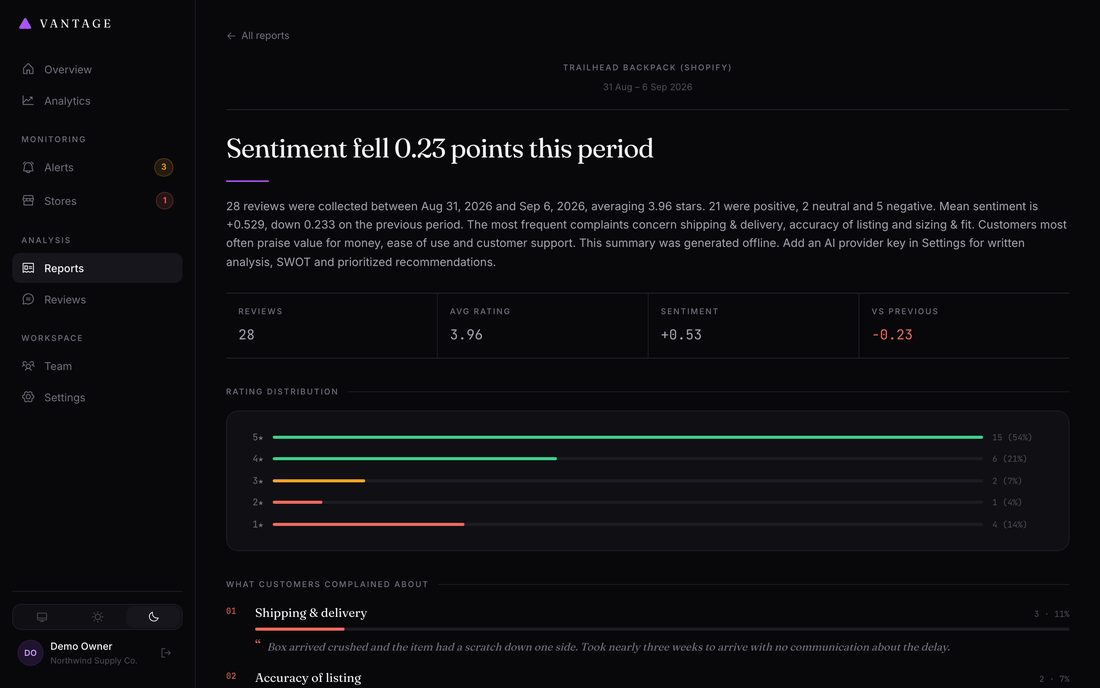
One sentence at the top summarizing the period. If sentiment fell sharply, that is the headline. If a third of your reviews were negative, that is the headline. If nothing much happened, it will say so — a quiet week is useful information.
The numbers
| Figure | What it means |
|---|---|
| Reviews | How many reviews were posted in this period. A small number makes everything else less reliable. |
| Avg rating | Mean star rating for the period. |
| Sentiment | Mean sentiment on a −1 to +1 scale. Roughly: above +0.2 is positive, below −0.2 is negative, in between is neutral. |
| vs previous | Change against the previous period. This is usually the most important number on the page. |
| Positive / neutral / negative | How the reviews split. |
Why sentiment and star rating can disagree
Star ratings are blunt. A reviewer who gives four stars and then writes two paragraphs about how the packaging arrived crushed is not a happy customer, and sentiment scoring catches that where the rating does not. When the two diverge, the text is usually telling you more.
The rating histogram
Under the numbers is a breakdown of how many reviews gave each star rating. Its shape tells you more than the average does: a product averaging 3.0 because everyone gives it three stars has a very different problem from one averaging 3.0 because half give five and half give one. The second is a consistency problem — usually manufacturing or fulfillment.
What customers complained about
The core of the report. Each theme shows:
- How many reviews mentioned it, and what share of the total that is
- A severity rating — high means more than one review in five mentions it
- A real customer quote, verbatim, so you can hear how it is actually described
What customers praised
Same structure, opposite direction. Useful for two things: knowing what not to change, and knowing what to put at the top of your listing copy. If reviewers keep mentioning battery life unprompted, that belongs in your product photos.
SWOT
Strengths, weaknesses, opportunities and threats — derived from what your reviewers actually said, not from a template.
| Quadrant | Where it comes from |
|---|---|
| Strengths | What customers consistently praise |
| Weaknesses | What they consistently complain about |
| Opportunities | Fixable problems, and things customers ask for |
| Threats | Trends that will damage the listing if they continue — a falling star average, rising returns risk |
What to do next
A ranked list of concrete actions, each with a reason and an estimated impact. These are specific — "add a measured size chart to the listing images" rather than "improve the customer experience". The first item is the one to do first.
How this report was produced
At the bottom of every report, collapsed by default, is exactly which engine produced it, how many tokens it used and what it cost. Worth checking occasionally so there are no surprises on your provider bill.
Regenerating a report
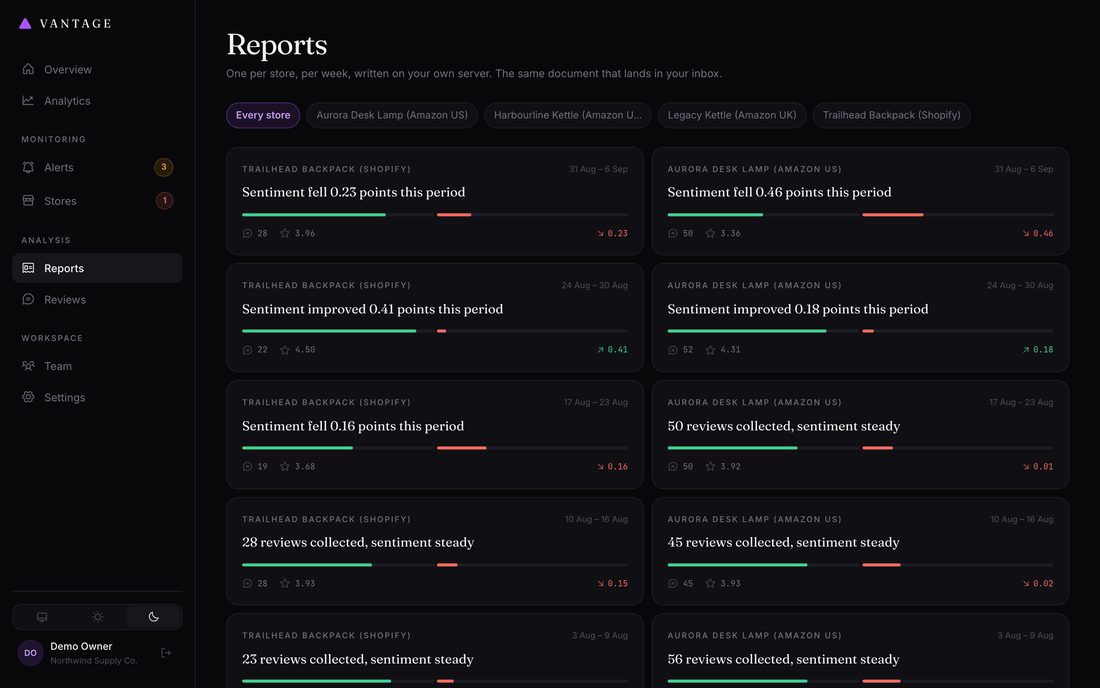
Use Regenerate on any report to rebuild it — useful after importing more reviews for that period or changing AI model. It replaces the existing report and, if AI is configured, uses tokens.
When a report says "not enough reviews"
Below five reviews in a period, Vantage declines to draw conclusions rather than producing something confident and wrong. Nothing is broken; there simply was not enough to say. It will try again next period.